Monday, March 30, 2009
Thursday, February 26, 2009
Raga Malti Basant – a rare fragrance of spring
I have had occasion to study Malti Basant while writing a commentary on a recording of it by Ulhas Kashalkar.
Malti Basant is a rare raga of the Marwa parent scale of Hindustani music. Amongst major authoritative sources, the solitary available reference I could find was from the Gwalior maestro, Narayanrao Patwardhan (Raga Vigyan, Vol. VI, 2nd Edition, 1964. Sangeet Gaurav Granthamala, Pune). Patwardhan describes the raga as a fusion of Puriya, Basant, Hindol and Sohini.
Ascent: SNrS/ SG/M^DS’
Descent: SNrND/ M^G/SMM^MG/ M^GrS.
The vadi-samvadi pair (the primary and secondary dominants) is identified as Dh and Ga. The various melodic component ragas are identified as follows:
Basant: M^GMGrS
Puriya: M^GrS-rSN
Hindol: SDNM^D
Sohini: SNrND.
Other than the Ulhas recording, the only readily available recording of the raga was an unpublished concert of Sharafat Hussain Khan (1930-1985) of Agra gharana. Interestingly, Sharafat renders the same vilambit bandish as Ulhas does.
Sharafat’s Malti Basant rendition confirms Dh and Ga as the vadi-samvadi pair of this raga. It also confirms that the raga’s centre of gravity lies in the lower half of the melodic canvas. However, in the poorvanga (lower tetrachord) Sharafat feels free to introduce a touch of Lalit in the raga (NrGM/M^MG) as a substitute for the Basant phrasing (SM/ M^MG). In the uttaranga (upper tetrachord), Sharafat tends to ignore the Hindol ascent (GM^DS’) in favour of the Sohini ascent (M^DNSrS).
In the recording, I also notice an occasional, obviously inadvertent, use of komal (flat) Dh in lieu of the shuddha (natural) Dh characteristic of this raga. In summary, it appears that Sharafat performs Malti Basant as a free amalgam of Marwa, Puriya and Sohini, adding to it a touch of Basant or Lalit with twin-Ma usage. Marwa and Puriya have a stronger presence in his rendering than Sohini because of the poorvanga bias of the raga. The Hindol facet of the raga is substantially played down. In the totality, however, the identifying features of the raga are under control.
Ulhas had the following comments about Malati Basant (message of June 5, 2003): “I have heard Malti Basant from my guru, Gajananrao, and from Latafat Hussain Khan and Babbanrao Haldankar. My impression is that this raga has been sung mainly in the Agra gharana. This raga is actually an old version of raga Basant, which used shuddha (natural) Dh instead of the komal (flat) Dh currently in use. According to Raga Vaibhav, a publication of Gandharva Mahavidyalaya, it was also known as “Mandir Basant”. Although the raga has shades of Puriya, Sohini as well as Basant -- there is no Hindol in it -- it is not a compound raga.”
As is to be expected in performances of rare raga-s, Ulhas’ treatment of the raga differs from its treatment by Sharafat Hussain. Throughout the alap of the vilambit khayal, the Puriya and Basant facets of the raga are treated as parts of a fundamentally seamless melodic entity. However, Ulhas does use the introduction of the Basant facet intermittently as an element of surprise in an otherwise Puriya dominant treatment of the raga. This gives the raga the semblance of a compound raga. The Sohini facet of the raga often gets accidentally highlighted when Ulhas chooses to vary a Puriya phrase (NDM^) and replaces it with a Basant flavoured phrase (NDM), creating an aural image, which approximates the Sohini descent (NDG). In the taans section, the raga takes on a different flavour. Because of the speed of execution, the intonation of Komal (flat) Re, which is already subdued in the Puriya facet of the raga, is subdued even further, while Ga gets emphasised, being an important melodic centre of the raga. As a result, the descending tans occasionally acquire a suggestion either of Hindol with Tivra (sharp) Ma or of Bhinna Shadja with shuddha (natural) Ma.
Historically, as Ulhas suggests, the raga may have evolved as a variant of an equally rare raga currently known as Shuddha Basant or Aadi Basant, also of the Marwa parent scale. This raga was apparently in reasonable circulation in the Dhrupad era, has been performed by Ustad Vilayat Khan in the early 1960’s (unpublished), and by the sitarist, Subroto Roy Choudhry on a CD published by India Archive Music, New York.
The two recordings on hand – those of Ulhas and Sharafat Hussain -- support the view that Malti Basant was not conceived as a compound raga. Like all rare ragas, the grammar of Malti Basant is fluid. These ragas have a few identifying features, which are probably defined by the few bandishes in circulation. Within the boundaries of the bandish, the raga is amenable to variable interpretation, without any major damage to its essential raga-ness.
(c) India Archive Music Ltd. New York
Malti Basant is a rare raga of the Marwa parent scale of Hindustani music. Amongst major authoritative sources, the solitary available reference I could find was from the Gwalior maestro, Narayanrao Patwardhan (Raga Vigyan, Vol. VI, 2nd Edition, 1964. Sangeet Gaurav Granthamala, Pune). Patwardhan describes the raga as a fusion of Puriya, Basant, Hindol and Sohini.
Ascent: SNrS/ SG/M^DS’
Descent: SNrND/ M^G/SMM^MG/ M^GrS.
The vadi-samvadi pair (the primary and secondary dominants) is identified as Dh and Ga. The various melodic component ragas are identified as follows:
Basant: M^GMGrS
Puriya: M^GrS-rSN
Hindol: SDNM^D
Sohini: SNrND.
Other than the Ulhas recording, the only readily available recording of the raga was an unpublished concert of Sharafat Hussain Khan (1930-1985) of Agra gharana. Interestingly, Sharafat renders the same vilambit bandish as Ulhas does.
Sharafat’s Malti Basant rendition confirms Dh and Ga as the vadi-samvadi pair of this raga. It also confirms that the raga’s centre of gravity lies in the lower half of the melodic canvas. However, in the poorvanga (lower tetrachord) Sharafat feels free to introduce a touch of Lalit in the raga (NrGM/M^MG) as a substitute for the Basant phrasing (SM/ M^MG). In the uttaranga (upper tetrachord), Sharafat tends to ignore the Hindol ascent (GM^DS’) in favour of the Sohini ascent (M^DNSrS).
In the recording, I also notice an occasional, obviously inadvertent, use of komal (flat) Dh in lieu of the shuddha (natural) Dh characteristic of this raga. In summary, it appears that Sharafat performs Malti Basant as a free amalgam of Marwa, Puriya and Sohini, adding to it a touch of Basant or Lalit with twin-Ma usage. Marwa and Puriya have a stronger presence in his rendering than Sohini because of the poorvanga bias of the raga. The Hindol facet of the raga is substantially played down. In the totality, however, the identifying features of the raga are under control.
Ulhas had the following comments about Malati Basant (message of June 5, 2003): “I have heard Malti Basant from my guru, Gajananrao, and from Latafat Hussain Khan and Babbanrao Haldankar. My impression is that this raga has been sung mainly in the Agra gharana. This raga is actually an old version of raga Basant, which used shuddha (natural) Dh instead of the komal (flat) Dh currently in use. According to Raga Vaibhav, a publication of Gandharva Mahavidyalaya, it was also known as “Mandir Basant”. Although the raga has shades of Puriya, Sohini as well as Basant -- there is no Hindol in it -- it is not a compound raga.”
As is to be expected in performances of rare raga-s, Ulhas’ treatment of the raga differs from its treatment by Sharafat Hussain. Throughout the alap of the vilambit khayal, the Puriya and Basant facets of the raga are treated as parts of a fundamentally seamless melodic entity. However, Ulhas does use the introduction of the Basant facet intermittently as an element of surprise in an otherwise Puriya dominant treatment of the raga. This gives the raga the semblance of a compound raga. The Sohini facet of the raga often gets accidentally highlighted when Ulhas chooses to vary a Puriya phrase (NDM^) and replaces it with a Basant flavoured phrase (NDM), creating an aural image, which approximates the Sohini descent (NDG). In the taans section, the raga takes on a different flavour. Because of the speed of execution, the intonation of Komal (flat) Re, which is already subdued in the Puriya facet of the raga, is subdued even further, while Ga gets emphasised, being an important melodic centre of the raga. As a result, the descending tans occasionally acquire a suggestion either of Hindol with Tivra (sharp) Ma or of Bhinna Shadja with shuddha (natural) Ma.
Historically, as Ulhas suggests, the raga may have evolved as a variant of an equally rare raga currently known as Shuddha Basant or Aadi Basant, also of the Marwa parent scale. This raga was apparently in reasonable circulation in the Dhrupad era, has been performed by Ustad Vilayat Khan in the early 1960’s (unpublished), and by the sitarist, Subroto Roy Choudhry on a CD published by India Archive Music, New York.
The two recordings on hand – those of Ulhas and Sharafat Hussain -- support the view that Malti Basant was not conceived as a compound raga. Like all rare ragas, the grammar of Malti Basant is fluid. These ragas have a few identifying features, which are probably defined by the few bandishes in circulation. Within the boundaries of the bandish, the raga is amenable to variable interpretation, without any major damage to its essential raga-ness.
(c) India Archive Music Ltd. New York
Tuesday, February 17, 2009
Gundecha Brothers--“Nobody invites a poor musician to perform”
Ramakant and Umakant Gundecha spoke to Deepak Raja on September 2, 1998In 1981, when we decided to join the Dhrupad Kendra in Bhopal as students, we both had Masters degrees in music, had received several years of training, and had reasonably secure jobs. But, both of us had this longing for music with much greater depth and substance.
Joining the Dhrupad Kendra meant relearning everything from a different perspective, and committing ourselves to Dhrupad as a career. Professionally, this was a high-risk decision to take in those days because the Dhrupad revival was yet to begin. We took the decision because it meant greater personal satisfaction to us as musicians.
In retrospect, there is no reason to regret that decision. We have never asked ourselves whether we might have done better as Khayal singers. Everything seems to have fallen into place. We have received the best possible taleem available in present times. Today, after receiving excellent training in Dhrupad, we are convinced that this is the only music that satisfies us. Over these years, the Dhrupad movement has also gained momentum.
We do not subscribe to the theory that the shortage of competent performers in Dhrupad, or its novelty for a majority of the audiences can explain what we have been able to achieve. Nobody invites a poor musician to perform, no matter how rare his style of singing is. Audiences do not come specifically to hear Khayal or Dhrupad. They come to hear classical music. You either qualify as a classical musician, or you don't. Nothing else matters. This is as true for us, as it was for the pioneers of the Dhrupad revival in modern times -- Ustad Nasir Ameenuddin and Nasir Moinuddin Dagar, better known as the Senior Dagar Brothers.
If we have been able to find a place in the major events of Hindustani music, it is because we are musicians of acceptable quality. The fact that we perform a genre that is not very widely practiced or heard, is an additional, but marginal, consideration.
In a broader context, and for the same reason, we are not in total sympathy with the concept of holding "Dhrupad Sammelans" as a means of promoting Dhrupad. Dhrupad already suffers from having been marginalized by a long absence of competent musicians. You cannot restore Dhrupad to a place of honor in classical music by perpetuating its isolation. You can do so only by producing outstanding musicians, who can compete effectively with performers of other genres in the mainstream of the music world.
And, this is where the distinctive quality of the Dagar gharana's music and its training appears. From the days of the Senior Dagar Brothers, it has become evident, that the style of this gharana has far greater appeal for contemporary audiences than the Dhrupad performed by other gharanas. A very important aspect of this training is the voice-culture practiced in the Dagar family. This training has made a great contribution to the public acceptance of the Dagar style of Dhrupad. And, it is now proven that the training of this gharana has the ability to produce outstanding musicians.
Our Ustads, Zia Moiuddin and Zia Fareeduddin Dagar have been virtual crusaders for the art of Dhrupad. In the Dagar tradition, they have been the first, the most committed, and the most successful as teachers of Dhrupad to students outside their own family. As teachers, they have produced more successful concert performers over the last 20 years than any other teacher of Dhrupad.
Their commitment and excellence as teachers of the basics of Hindustani music -- the science of intonation, voice culture, the achievement of tonal precision, handling of the raga form, the achievement of its emotional impact, and disciplined creativity -- has been outstanding.
Today, these are claimed as special features of Dhrupad perhaps because thorough taleem in these aspects is no longer available to Khayal singers. But, they are fundamental to Hindustani vocal music, and it is important that these disciplines are being preserved at least in the Dhrupad gharanas.
When we call something "Shastriya Sangeet" -- whether Dhrupad, or Khayal, -- it has to be, by its very definition, music which has a "Shastra", a sound theoretical foundation. And the performing art has to retain an intimate relationship with a tradition of scholarship.
We might surmise that Dhrupad, which is today considered to have a superior grounding in "Shastra", probably declined when it drifted away from its moorings in the "Shastra". By the same logic, we might say that those Dhrupad traditions which have survived, and are growing in acceptance, are those that have retained their fundamental soundness.
In addition to the soundness of the basics, the Dagar style has remained popular because it concentrated on the melodic facets of Dhrupad's esthetic appeal. In doing so, it subordinated the role of percussion to the melodic facet of music.The overly masculine or aggressive musical expression does not find place in the Dagar style. They have preserved a strong bias in favour of the elaborate alap of the Dhrupad tradition, and meticulously observed the relationship between the poetic and melodic forms.
The same esthetic perspective dominates the choice of compositions in the Dagar tradition. Although we sing compositions in a variety of Talas -- Chautal, Dhamar, Sul, Tivra, Matta Tal, and Jhaptal -- we do not sing any compositions without a poetic element. Compositions with meaningless consonants -- prevalent in other Dhrupad traditions -- are not performed in the Dagar style. The Dagars have taken the view that there is enough melodic development with meaningless consonants in the Nom-Tom alap, and extending it into rendition of compositions of the Tarana variety is unnecessary.
Beyond these general features of the Dagar style, our Ustads have sought to build a closer relationship between Dhrupad music as sung, and as performed on the Rudra Veena. Although vocal music and the Rudra Veena have always been companions in the Dhrupad tradition, the "Been Ang" (lit:the style of performing on plucked instruments, specifically of the fretted lute family) influences our own singing much more than has traditionally been the case. This appears to have a special appeal for contemporary audiences nurtured in an age dominated by the Sitar, Sarod, and the Santoor.
Against this background of the gharana and our taleem with our Ustads, we ourselves have tried to introduce elements which make for wider acceptability of our music.
The main effort we have made is in the field of the poetic element. We realized that in the Khayal-dominated era, the poetic element is faded into relative insignificance, both in terms of the musicians' presentation of it, and the audiences' receptivity to it. Dhrupad has to treat poetry with respect. Therefore, it must make an effort to adopt a more modern literary idiom.
We have selected some medieval and even modern poetry, and cast it into the melodic framework of traditional Dhrupad compositions. And, this has received a very encouraging response from audiences. We also felt the need to create compositions in currently popular ragas, such as Charukeshi (a Carnatic raga, introduced to Hindustani music less than 50 years ago). We selected poetry for such compositions, cast them into melodic-rhythmic frameworks, obtained the approval of our Ustads on the soundness of the compositions, and have started performing them. This, too, has been very well received by audiences.
In our presentation, we tend to avoid the “ladant-bhidant” relationship between the vocal music and the percussion accompaniment. Our melodic development receives a "theka" support just as in Khayal presentation, although we certainly have a much more lively interaction with percussion in the rhythmic play than Khayal. We also provide our percussion accompanists ample spaces for Pakhawaj solo passages, just as Sitar and Sarod players do.
This is not merely a concession to the expectations of audiences nurtured by post-Dhrupad musical genres. It is also critical to preserving the melody-dominant character of the Dagar gharana's music without denying the rhythmic element and percussion its due share of importance.
In India, we find that almost 70% of our audiences are hearing Dhrupad for the first time. Most of them are below the age of 40. Thanks to the media coverage of Dhrupad, and of our own careers, the younger audiences appear to have a strong curiosity about Dhrupad. They see it as being perhaps more authentically Indian than Khayal or Thumree music merely by virtue of being older. But, what is important is that they are liking what they hear. One of the reasons might well be that Dhrupad is more accessible to uninitiated audiences than Khayal because of the separation of the melodic from the rhythmic. This separation frees them from the simultaneous need to keep track of melodic and rhythmic manipulation.
But, the more important aspect of audience acceptance is that it is the alaps that are more widely appreciated. The taste for the elaborate alap might have been created by the great instrumentalists of our times, who have retained the three-tiered Dhrupad style alap in their music and popularized it. Because the Dhrupad alap has become familiar through instrumental music, and probably Khayal is losing its contemplative, soulful movements, audiences could be appreciating this facet of Dhrupad even more.
A broadly similar picture emerges amongst audiences in the US and Europe. Relative to the size of Khayal-oriented audiences, the Dhrupad-oriented audiences are larger in the West than in India. The mystique of an "ancient" art form, of course, has a greater appeal for Western audiences. But, they too value the Dhrupad alap more than the compositions, and for the same reasons as Indian audiences.
With a resurgent market in India and in the West, naturally the drift of promising talent towards Dhrupad is now snowballing. The Dhrupad Kendra at Bhopal is now attracting exceptional talent in good numbers. We, the Gundecha Brothers, are ourselves planning to set up a residential Gurukul-type Dhrupad institute shortly, and plan to select at least 10 students for prolonged intensive training. Looking at the overall trends, we feel confident that in the next couple of decades, there will be at least three times as many competent Dhrupad singers on the mainstream platform as there are today.
The situation regarding Pakhawaj is also improving fast. The growing popularity of Dhrupad has created a shortage of competent Pakhawaj players. The few competent Gurus we have today are experiencing an ample demand for their training. Hopefully, the next generation of Dhrupad vocalists will not have to face the same shortage of percussion accompanists as we have had to live with.
Unfortunately, unlike the Tabla, the market for Pakhawaj solos has not yet developed well enough to make Pakhawaj more attractive as career. To give a boost to this art form, we sometimes encourage our Pakhawaj accompanists to present short solo items at the end of our concerts. But, considering that even Tabla solos have a shrinking market, a Pakhawaj solo market may be a long way off.
Dhrupad is now being re-integrated into the mainstream. The issues of making a decent living that should have troubled us when we opted for Dhrupad, need not bother the most promising Dhrupadiyas of the next generation.
The current trends in Dhrupad presentation and audience acceptance will, we feel, persist and mature over the next few decades. The Dagar style will continue to grow in popularity.
As an interesting, but related, phenomenon, the Agra gharana of Khayal music, which retains the strongest link with its Dhrupad ancestry, could ride back to popularity on the strength of its Dhrupad flavor.
Yes, just as we have made a few minor innovations in Dhrupad presentation, there may be some more to come. But, Dhrupad cannot change very much without losing its identity. And, judging from the emotional and esthetic needs of audiences, it does not seem that they want it to change too much, either.
Reproduced, with the publisher’s consent, from “Perspectives on Dhrupad”, edited by Deepak Raja, and Suvarnalata Rao, published by the Indian Musicological Society, Baroda/ Bombay. 1999
Tuesday, January 27, 2009
Sunday, January 4, 2009
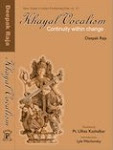
Khayal Vocalism: Continuity within Change

Author: Deepak Raja
Foreword: Pandit Ulhas Kashalkar
Introduction: Lyle Wachovsky
Publisher: DK Printworld, New Delhi
Paperback: Rs. 460.00. Hard-cover: Rs. 760.00
Preview
“Deepak Raja’s work is surely the most important contribution to literature on khayal vocal styles to come out in recent times. His minute and colorful analysis is astounding testimony to decades of deep aesthetic and intellectual engagement. His parsing of the formidable variables of Khayal style here is a real gift to those of us who have puzzled over the elusive qualities of this beautiful music. His essays on selected musicians are both enlightening and entertaining. I recommend this book to anyone who listens thoughtfully to India's classical music.”
Prof. Allyn Miner
Department of South Asian Studies
University of Pennsylvania, Philadelphi, USA
Deepak Raja has adopted a unique kind of systematic analytical approach to the study of Hindustani music, which yields original and intriguing insights. Students and lovers of Indian music will find much that is compelling and thought-provoking in this book.
Prof. Peter Manuel
Professor of Music, John Jay College, New York,USA
“This book is a pioneering effort in the study of Hindustani Music. I know of no previous work that pays as much attention to detailed analysis of the individual stylistic characteristics of the great vocalists of the past. Moreover, the analysis is firmly grounded in an extensive study of a large array of recordings. This feature by itself is a huge departure from the established norms in past writing on this subject, in which the treatment has been with a broad brush, thereby often leading to generalities that are not objectively sustainable. Here an attempt is made to impose some rigor in this process, by relying on material that is available for detailed analysis – such as recordings, interviews and so on.
“Here, Deepak Raja applies to stylistic analysis a metaphor he previously originated, applying ideas from the plastic arts to the study of khayal styles. This metaphor involves looking at the total phenomenon of creativity in khayal styles as a meld of three facets: an architectural facet, a sculptural facet, and an ornamental facet. This point of view is original, stimulating and effective, and provides a conceptual and analytical framework for understanding Khayal stylistics. The reader will find much here that is of interest historically as well as musically. This book should be required reading for every serious student of music whose vision goes beyond performance alone. We are in Deepak Raja's debt for an outstanding book.”
Prof. Ramesh Gangolli.
University of Washington, Seattle, USA
“Basing the findings and conclusions on pointed instances from audio-recordings, using physical parameters for analysis and yet treating the art as an organic form, keeping the discussion restricted to the musician's music alone, the felicity in the use of language – impart objectivity, dignity and intimacy to Deepak Raja's writings on music. His deep knowledge of the music of the stalwarts and his eagerness to recognise and understand the music of the most recently risen artist have carried this book ahead of and beyond the earlier writings on the Khayala music.”
Prof. N Ramanathan
Professor of Music (Retd.), University of Madras
Currently, Adjunct Professor of Music, Chennai Mathematical Institute.
Deepak Raja has achieved a unique synthesis of articulate musical description and thoughtful cultural background. He supports and respects the traditions of Hindustani classical music; but manages to achieve the personal distance necessary to avoid the emotional and analytic excesses of many volumes in this field. “Khayal Vocalism” offers scholars an important alternative perspective on Indian musical priorities and thinking; it is essential for the interested listener (Indian or foreigner) who wishes to reach a better understanding of the most important vocal form in the classical music of 20th Century India.
Prof. Gregory Booth, Department of Ethnomusicology,
University of Auckland, New Zealand
“I am not an authority on Indian Classical music to ably judge the scholastic quality of “Khayal Vocalism”. But I know Deepak Raja and the dedication with which he works on a chosen project. Going through “Khayal Vocalism” I was highly impressed by Shri.Raja’s expertise and deep passion for the subject. I am confident that readers will find his analysis of great value”.
Mrs. Vijaya Mehta
Executive Director, National Centre for the Performing Arts, Mumbai
“Scholarly and meticulously researched, this is an extremely valuable book on Indian classical music.”
Namita Devidayal
Author of “The Music Room” (Random House, 2008)
"Like all Deepak Raja's writings on Hindustani music, including his earlier work, "Hindustani Music--a Tradition in Transition", the present work too impresses with the knowledge, information, candour, analytical acuity and felicity of expression that he has brought to it. Art music is rarely written about in such a clear, readable manner."
Shanta Gokhale
Culture columnist and theatre personality
“Assimilate like a student, analyse like a master, express like an artist. This has been the hallmark of scholar-musician Deepak Raja’s approach, making this wonderful book a seeker’s destination and a reader’s odyssey”
Ashok Roy
Author of “Music Makers” (Rupa, 2004)
To me Deepak Raja or Deepakbhai as I call him, is a senior disciple, a talented musician, a respected journalist, a critical analyst of Indian music and a close family friend.
As an author, his first book “Hindustani Music: a tradition in transition”, written in lucid and scholarly language, is much in demand. His second book -- “Khayal Vocalism: continuity within change” -- projects profound analysis of the vocal form of Khayal. His conclusions which maintains “Continuity within Change” is indeed thought provoking. I am sure it will be extremely useful to academically interested musicians as well as aspiring students.
Pandit Arvind Parikh
Eminent sitarist, and
President, Indian Musicological Society
I have known Deepak Bhai for a long time. I have seen his association with my Ustaad and father, Ustad Vilayat Khan and we have spent some wonderful times discussing music. His thoughts on our music and tradition I have always found to be very refreshing and I feel that he expresses them with a great amount of clarity. I always look forward to our meetings and our long chats.
Ustad Shujaat Khan, Sitarist
“As in his earlier book, -Hindustani Music – A tradition in transition”, Deepak Raja continues to provide a fresher and analytic evaluation of the changing profile of the khayal style in this book, covering all the major khayal gharanas of Hindustani music. Continuity and change is profoundly explained by the author. Scholar, performer and connoisseur –all will benefit from the reading of this valuable book.”
Prof. RC Mehta
Prof. of Music (Retd), M.S. Univ. of Baroda,
Founder – Editor, Journal of the Indian Musicological Society.
"Deepak Raja's book on Khayal vocalism is a remarkable output of research done over the years. He is one of the most outstanding musicologists I have ever come across, not only because of the depth of his scholarship in the field, but also because of his ability to think like a very sensitive performer. I am definite there will be wide appreciation of this masterly work"
Prof. Sugata Marjit
North Indian Classical Vocalist and
Director, Centre For Studies in Social Sciences, Kolkatta
“During my work in the Musicology department of the National College of Arts, Lahore and in the Sanjan Nagar Institute I have found Deepak Raja’s commitment to our classical music and his painstaking scholarship to be a very valuable asset. We have benefited greatly from his past writings and looking at his latest work I find it an even more valuable link in our fund of serious writings. We extend our gratitude and look forward to a further continuation of his important work in the realm of Indian Classical Music.”
Raza Kazim
Director, Sanjan Nagar Institute of Musicology,
Lahore, Pakistan
“Deepak Raja’s contributions to Sruti magazine have been weighty in substance but also very readable, addressed to the serious music lover, not the scholar. He is an editor’s delight; his copy needs no editing, and he has perfect understanding of the ideal length for the extremely readable profiles of khayal musicians, which we serialised in Sruti, and appear in this book. Here’s a role model for all aspiring writers on the arts—analytical and completely focused on the art and the process, not anecdotal like much writing we see in this genre.”
V Ramnarayan
Editor, SRUTI Magazine, Chennai
Friday, December 19, 2008
Raga Ahiri: Neither Ahiri Todi, nor Ahir Bhairav – just Ahiri
Until a few years ago, I had not heard Raga Ahiri. The opportunity of studying it came my way when I had to write a commentary on the sarodist, Tejendra Majumdar’s recording of this raga for India Archive Music Ltd., New York.
Tejendra claims to have learnt this raga from his Guru, Ustad Bahadur Khan, as Ahiri, and not Ahiri Todi. In addition, he studied, from a private collection, an unpublished recording of the raga rendered by Nikhil Bannerjee. Tejendra vouches that the raga form, as taught to him by his Guru matches that of Nikhil Bannerjee. On this evidence, I am inclined to believe that Ahiri is a rare raga, which has been a part of the repertoire of the Maihar-Seniya repertoire.
The word "Ahir" refers to a community of cowherds in northern and western India. This suggests the origin of this raga in a tribal or folk melody, which entered the raga system by shaping variants of mature, major ragas. This possibility is suggested by the popularity of its compounds (e.g. Ahir Bhairav, Ahiri Todi, Ahir Lalit) and the rarity of the pure Ahiri.
Such situations are encountered when the pure form of a raga is either too similar to established ragas to sustain its independent raga-ness, or too limited in melodic potential to permit a sufficiently satisfying presentation. Isolating the pure form of ragas like Ahiri from their compounds -- conceptually as well as in practice -- is therefore a challenging task. Consequently, we encounter a variety of interpretations of such ragas in rendition, along with a scarcity of documentation, and lack of consistency in nomenclature and grammar.
In such situations, a residual derivation is occasionally possible with one of two approaches:
1. Ahiri = (Ahir Bhairav - Bhairav) or (Ahiri Todi - Todi)
2. Ahiri = {(Ahir Bhairav + Ahiri Todi) - Bhairav - Todi}
Considering that Ahiri appears, over the years, to have so totally submerged its identity into its compounds, neither of these derivations is particularly helpful. Tejendra Majumdar's Ahiri, therefore, requires us to accept it on its own terms, to be interpreted in relation to the most familiar reference points available.
Swara-samudaya (tone material):
Ahiri (Tejendra's interpretation): S r g M P D n
This interpretation combines the Bhairavi scale of Hindustani music in the purvanga (lower tetrachord), with the Kafi scale in the uttaranga (upper tetrachord). Apparent dominants: Komal Re and shuddha Ma. Their relative weightage is not possible to determine.
Subba Rao's documentation: (Subba Rao V. Raga Nidhi, Vol.I and IV. Fourth Impression, 1996, Music Academy, Madras)
Ahiri: S r G M P D n (Dominants: Primary: Sa. Secondary:Pa)
Ahir Bhairav: S r G M P D n (Dominants: Primary: Ma. Secondary:Sa)
Ahiri Todi: S r g M P d n N (Dominants: Primary: dh. Secondary:ga)
Ahir- Lalit: S r G M M^ D n (Dominants: Primary: Ma. Secondary:Sa)
On the dimensions of swara-samudaya and dominant swaras, Majumdar's Ahiri does not correspond to any of these raga parameters. It does, however, correspond to the swara-samudaya of Ahiri Todi, as documented by Manikbuwa Thakurdas, a scholar-musician of the Gwalior Gharana (Raga Darshan: Vol. III, First edition. Shri Lakshminarayan Trust, Rajpipla). The Thakurdas description of Ahiri Todi also approximates Tejendra's rendition in terms of aural images. According to Thakurdas, the purvanga of Ahiri Todi suggests raga Bilaskhani Todi, while the uttaranga corresponds to raga Ahiri.
Beyond this, the Thakurdas commentary becomes unserviceable. It states that Ahiri Todi and Ahir Bhairav are the same raga, and a documentation of the pure Ahiri is not available, though the raga finds mention in respected musicological texts. Moreover, Thakurdas considers Pa and Sa as the primary and secondary dominants, respectively, of Ahiri Todi. This conflicts with Subbarao's parameters for Ahiri, Ahir Bhairav and Ahiri Todi, as also with Tejendra's rendition of Ahiri.
These references, considered along with Tejendra's rendition, suggest two melodic tendencies of the pure Ahiri. With identical swara-samudaya for Ahiri and Ahir Bhairav, and using the shuddha (natural) Ga, Subba Rao apparently considers the pure Ahiri close to Bhairav. Tejendra's interpretation, on the other hand, uses the komal (flat) Ga, and suggests a proximity to the Todi group of ragas. Available evidence is insufficient to ascertain whether Ahiri and Ahiri Todi might have, at some stage or in some gharanas, been different names for the same raga.
Tejendra's own contribution to the interpretation of this raga seems considerable. The melodic personality of the raga has an impressionistic modernity which is inconceivable as having derived from either Ustad Bahadur Khan or Pt. Nikhil Bannerjee. This modernity is reflected mainly in the use of kaleidoscopic tonal patterns, which are compatible with the tone material of the raga, but lack well-defined melodic contours. This is, essentially, a post-Ali Akbar feature in sarod music, and assists greatly in projecting a persuasive holograph of a rare raga, whose distinctive melodic identity is difficult to sustain.
In simplistic terms, Tejendra's Ahiri is vaguely suggestive of Bilaskhani Todi/ Bhairavi in the purvanga and Bageshri in the uttaranga. The Bageshri flavor is also found in the uttaranga of Ahir Bhairav, and may therefore be assumed to belong to Ahiri. As performed by Tejendra, Ahiri exhibits a family resemblance with Ahir Bhairav and Ahiri Todi. Because of the raga's purvanga-dominant character, the Todi bias might prevail.
Chalan (Skeletal phraseology)
n.D.r/D.n.S /D.n.g r /r g M g r /S r g M /r g P M /g r g P /r g M D /D P D n D /M D S' (or) M P D n S' (or) M D n S' /D n r' S' /n D P D n D /n D M g r /P M g r /r n. D. S
In the phraseology, the dominant melodic foci are komal (flat) Re, shuddha (natural) Ma and shuddha (natural) Dh. In the alap. Tejendra appears to treat the komal Re as the pivotal swara. The two compositions he performs have their primary emphasis on the shuddha Ma, defining this swara as the second dominant. The importance of Ma probably belongs to the original Ahiri, considering that it is inconsistent with the character of Bhairav but is frequently encountered in renditions of Ahir Bhairav by scholarly musicians. This emphasis on Ma is important also because it weakens the adjacent komal Ga and komal Re, both pregnant with a bias towards the Todi group. In the ambient acoustic, Tejendra emphasizes Ma and Dh swaras, thus reinforcing the Bageshri chord, presumably supportive of the aural image of Ahiri.
Ahiri is prescribed for mid-morning performance. Consistent with its Todi/Bhairav affinity and purvanga bias, the dominant mood of this raga is somber. Despite the mildly euphoric potential of the shuddha (natural) Ma as a melodic focus, Tejendra's interpretation appears to veer towards pathos.
Tejendra's Ahiri is a complex raga to handle. Establishing Ahiri as distinct from the familiar Ahir Bhairav and Ahiri Todi, while retaining a family resemblance to them, is a task demanding formidable musicianship.
(c) India Archive Music Ltd., New York. Tejendra Majumdar's recording of Raga Ahiri is available from India Archive Music.
Tejendra claims to have learnt this raga from his Guru, Ustad Bahadur Khan, as Ahiri, and not Ahiri Todi. In addition, he studied, from a private collection, an unpublished recording of the raga rendered by Nikhil Bannerjee. Tejendra vouches that the raga form, as taught to him by his Guru matches that of Nikhil Bannerjee. On this evidence, I am inclined to believe that Ahiri is a rare raga, which has been a part of the repertoire of the Maihar-Seniya repertoire.
The word "Ahir" refers to a community of cowherds in northern and western India. This suggests the origin of this raga in a tribal or folk melody, which entered the raga system by shaping variants of mature, major ragas. This possibility is suggested by the popularity of its compounds (e.g. Ahir Bhairav, Ahiri Todi, Ahir Lalit) and the rarity of the pure Ahiri.
Such situations are encountered when the pure form of a raga is either too similar to established ragas to sustain its independent raga-ness, or too limited in melodic potential to permit a sufficiently satisfying presentation. Isolating the pure form of ragas like Ahiri from their compounds -- conceptually as well as in practice -- is therefore a challenging task. Consequently, we encounter a variety of interpretations of such ragas in rendition, along with a scarcity of documentation, and lack of consistency in nomenclature and grammar.
In such situations, a residual derivation is occasionally possible with one of two approaches:
1. Ahiri = (Ahir Bhairav - Bhairav) or (Ahiri Todi - Todi)
2. Ahiri = {(Ahir Bhairav + Ahiri Todi) - Bhairav - Todi}
Considering that Ahiri appears, over the years, to have so totally submerged its identity into its compounds, neither of these derivations is particularly helpful. Tejendra Majumdar's Ahiri, therefore, requires us to accept it on its own terms, to be interpreted in relation to the most familiar reference points available.
Swara-samudaya (tone material):
Ahiri (Tejendra's interpretation): S r g M P D n
This interpretation combines the Bhairavi scale of Hindustani music in the purvanga (lower tetrachord), with the Kafi scale in the uttaranga (upper tetrachord). Apparent dominants: Komal Re and shuddha Ma. Their relative weightage is not possible to determine.
Subba Rao's documentation: (Subba Rao V. Raga Nidhi, Vol.I and IV. Fourth Impression, 1996, Music Academy, Madras)
Ahiri: S r G M P D n (Dominants: Primary: Sa. Secondary:Pa)
Ahir Bhairav: S r G M P D n (Dominants: Primary: Ma. Secondary:Sa)
Ahiri Todi: S r g M P d n N (Dominants: Primary: dh. Secondary:ga)
Ahir- Lalit: S r G M M^ D n (Dominants: Primary: Ma. Secondary:Sa)
On the dimensions of swara-samudaya and dominant swaras, Majumdar's Ahiri does not correspond to any of these raga parameters. It does, however, correspond to the swara-samudaya of Ahiri Todi, as documented by Manikbuwa Thakurdas, a scholar-musician of the Gwalior Gharana (Raga Darshan: Vol. III, First edition. Shri Lakshminarayan Trust, Rajpipla). The Thakurdas description of Ahiri Todi also approximates Tejendra's rendition in terms of aural images. According to Thakurdas, the purvanga of Ahiri Todi suggests raga Bilaskhani Todi, while the uttaranga corresponds to raga Ahiri.
Beyond this, the Thakurdas commentary becomes unserviceable. It states that Ahiri Todi and Ahir Bhairav are the same raga, and a documentation of the pure Ahiri is not available, though the raga finds mention in respected musicological texts. Moreover, Thakurdas considers Pa and Sa as the primary and secondary dominants, respectively, of Ahiri Todi. This conflicts with Subbarao's parameters for Ahiri, Ahir Bhairav and Ahiri Todi, as also with Tejendra's rendition of Ahiri.
These references, considered along with Tejendra's rendition, suggest two melodic tendencies of the pure Ahiri. With identical swara-samudaya for Ahiri and Ahir Bhairav, and using the shuddha (natural) Ga, Subba Rao apparently considers the pure Ahiri close to Bhairav. Tejendra's interpretation, on the other hand, uses the komal (flat) Ga, and suggests a proximity to the Todi group of ragas. Available evidence is insufficient to ascertain whether Ahiri and Ahiri Todi might have, at some stage or in some gharanas, been different names for the same raga.
Tejendra's own contribution to the interpretation of this raga seems considerable. The melodic personality of the raga has an impressionistic modernity which is inconceivable as having derived from either Ustad Bahadur Khan or Pt. Nikhil Bannerjee. This modernity is reflected mainly in the use of kaleidoscopic tonal patterns, which are compatible with the tone material of the raga, but lack well-defined melodic contours. This is, essentially, a post-Ali Akbar feature in sarod music, and assists greatly in projecting a persuasive holograph of a rare raga, whose distinctive melodic identity is difficult to sustain.
In simplistic terms, Tejendra's Ahiri is vaguely suggestive of Bilaskhani Todi/ Bhairavi in the purvanga and Bageshri in the uttaranga. The Bageshri flavor is also found in the uttaranga of Ahir Bhairav, and may therefore be assumed to belong to Ahiri. As performed by Tejendra, Ahiri exhibits a family resemblance with Ahir Bhairav and Ahiri Todi. Because of the raga's purvanga-dominant character, the Todi bias might prevail.
Chalan (Skeletal phraseology)
n.D.r/D.n.S /D.n.g r /r g M g r /S r g M /r g P M /g r g P /r g M D /D P D n D /M D S' (or) M P D n S' (or) M D n S' /D n r' S' /n D P D n D /n D M g r /P M g r /r n. D. S
In the phraseology, the dominant melodic foci are komal (flat) Re, shuddha (natural) Ma and shuddha (natural) Dh. In the alap. Tejendra appears to treat the komal Re as the pivotal swara. The two compositions he performs have their primary emphasis on the shuddha Ma, defining this swara as the second dominant. The importance of Ma probably belongs to the original Ahiri, considering that it is inconsistent with the character of Bhairav but is frequently encountered in renditions of Ahir Bhairav by scholarly musicians. This emphasis on Ma is important also because it weakens the adjacent komal Ga and komal Re, both pregnant with a bias towards the Todi group. In the ambient acoustic, Tejendra emphasizes Ma and Dh swaras, thus reinforcing the Bageshri chord, presumably supportive of the aural image of Ahiri.
Ahiri is prescribed for mid-morning performance. Consistent with its Todi/Bhairav affinity and purvanga bias, the dominant mood of this raga is somber. Despite the mildly euphoric potential of the shuddha (natural) Ma as a melodic focus, Tejendra's interpretation appears to veer towards pathos.
Tejendra's Ahiri is a complex raga to handle. Establishing Ahiri as distinct from the familiar Ahir Bhairav and Ahiri Todi, while retaining a family resemblance to them, is a task demanding formidable musicianship.
(c) India Archive Music Ltd., New York. Tejendra Majumdar's recording of Raga Ahiri is available from India Archive Music.
Wednesday, December 10, 2008
Purva and Puriya Kalyan: What’s the difference?
Purva (also called Purvya) belongs to a cluster of ragas bearing a family resemblance to raga Puriya in terms of swara material, and phraseology, melodic center of gravity, and therefore aural impression.
Swara material
Puriya: S r G M^ D N
Puriya-Dhanashree: S r G M^ P d N
Poorvi: S r G M M^ P d N
Puriya-Kalyan/Purva: S r G M^ P D N
What is common to all of them is komal (flat) Re, shuddha (natural) G, tivra (sharp) Ma, and shuddha (natural) Ni.
At the commencement of a concert at Los Angeles CA in 1991, Ustad Vilayat Khan introduced Purva with its ascent and descent.
Ascent: N r G M^ D N r' G'
Descent: r' S' N D P M^ G M^ r G\ N. r S
In a tape-recorded interview after the concert, the Ustad says that Purva is the same as the raga commonly known as Puriya Kalyan. He also argues that Purva is the right name for this raga and Puriya Kalyan is misleading because there is no trace of the characteristic Kalyan element in Puriya Kalyan. Although he does not identify the "characteristic Kalyan element", he probably considers the shuddha (natural) Re swara as essential for the Kalyan classification. If this is his argument, it has some validity.
Kalyan is a family of post-sunset ragas, which should use the shuddha (natural) Re swara. The komal (flat) Re of the Puriya cluster defines Purva as a "sandhi-prakash" (twilight zone, in this case, sunset-hour) raga. By this logic, Puriya Kalyan cannot be classified with the Kalyan family.
With these observations, Ustad Vilayat Khan has raised the issue: Are Purva and Puriya Kalyan two different ragas, or two names for the same raga?
Musicologist VN Bhatkhande looked at this issue in the 1940's, when Purva was a mature raga, and Puriya Kalyan had just begun to gain acceptance. Based on textual evidence, but very limited exposure to performances of Puriya Kalyan, Bhatkhande concluded that they are, indeed, different ragas. (Bhatkhande Sangeet Shastra. Vol.III, Ed.LN Garg, Sangeet Karyalaya Hathras, third edition, 1984. Pgs. 251-254)
Genealogically, Bhatkhande connects Puriya Kalyan to raga Purva Kalyan of the Gamanashram parent scale in the Carnatic (South Indian) tradition, which has identical swara material, and near-identical scale. Purva, on the other hand, he attributes to a combination of Poorvi, Maru and Gaura.(Ibid)
During the review of this recording, Ustad Vilayat Khan described Purva as Puriya with a Pa added to it,or Puriya Dhanashree with a shuddha (natural) Dh swara replacing the komal (flat) Dh. Therefore, it appears that the Ustad saw Purva clearly as a member of the Puriya cluster. However, it is also possible to interpret the same scale as Yaman with a komal (flat) Re replacing the shuddha (natural) Re. And, this may very well explain why the Carnatic nomenclature of this scale associates the raga with Kalyan (Yaman).
Thus, Ustad Vilayat Khan plays Puriya with a Pa and calls it Purva. And, Puriya Kalyan specialists perform a raga to the same scale, probably conceived as Yaman with a komal (flat) Re. What is the difference ?
To explore this issue, we can compare Vilayat Khan's Purva with the Puriya Kalyan of its most popular exponent, Pt. Bhimsen Joshi (Music Today: A:97009).
The most obvious conclusion is that neither Purva of Vilayat Khan, nor Puriya Kalyan of Bhimsen Joshi can escape the aural images of either Puriya or Yaman. Both the maestros also use the suppressed micro-swara of the komal (flat) Re characteristic of Puriya. A detailed examination of their respective phraseologies also fails to identify any distinctive phrase that one of them uses, and the other does not.
However, the aural experience they create is distinctive. Purva does, indeed, come through as closer to Puriya, and Puriya Kalyan does emerge as being inspired more by Yaman. The secret probably lies in the probabilistic technique of raga differentiation.
If you play Yaman with a komal (flat) Re, the ascent becomes pure Puriya anyway, while the descent remains Yaman until it reaches Ga, and returns to Puriya below it. Thus, if more phrases are ascending, and fewer are descending, Puriya dominates the aural experience. And, vice versa.
The second aspect of this same probabilistic technique is how much melodic development is done in the mid-octave region, where the Yaman flavor is dominant. If you de-emphasize the melodic development in the mid-octave region, Puriya can dominate the aural experience. And, vice versa.
The third facet of this technique is the use of multiple phraseologies. If you use the Puriya descent in the upper tetrachord (N-D-M^) in addition to the Yaman descent (N-D-P), and do so often enough, Puriya dominates. By the same logic, if you use the Yaman-type ascent in the lower tetrachord (N-r-G-M^-P) in addition to the Puriya ascent (N-r-G or N-r-M^-G), and do so often enough, the Yaman flavor dominates.
Allied to this approach is the inclusion/ exclusion technique of raga differentiation. If the Yaman flavor surfaces in the mid-octave region, it is possible to highlight the Yaman angle, or balance the two, by including the mid-octave region in a majority of phrases. This means using a phraseology, on an average, of broader melodic spans. Conversely,the Puriya facet is more easily isolated, by using phrases, on an average, of shorter melodic spans so that the mid-octave region can be excluded, when desired.
The probabilistic technique of raga differentiation is the most subtle and advanced of all melodic disciplines. On the basis of permissible phraseologies, the two ragas are identical. The only technique for differentiating them is through differential weightages given to different segments of the octave.
It is difficult for two ragas of such subtle differentiation to co-exist with anything like comparable circulation or popularity. It is a different matter – though not entirely irrelevant – that even audiences of considerable cultivation would find the differences imperceptible. Consequently, it appears that Puriya Kalyan, with the commonly understood Yaman as its reference point, has remained in circulation. And, Purva, with the more profound Puriya reference point, is now rarely heard.
This point of view is at variance with contemporary scholars and learned musicians, including Ustad Vilayat Khan, who regard Purva as the original name for the present-day Puriya Kalyan. The debate can continue.
© India Archive Music Ltd. New York. An outstanding recording of Raga Purva by Ustad Vilayat Khan (1991) is available from India Archive Music Ltd.
Swara material
Puriya: S r G M^ D N
Puriya-Dhanashree: S r G M^ P d N
Poorvi: S r G M M^ P d N
Puriya-Kalyan/Purva: S r G M^ P D N
What is common to all of them is komal (flat) Re, shuddha (natural) G, tivra (sharp) Ma, and shuddha (natural) Ni.
At the commencement of a concert at Los Angeles CA in 1991, Ustad Vilayat Khan introduced Purva with its ascent and descent.
Ascent: N r G M^ D N r' G'
Descent: r' S' N D P M^ G M^ r G\ N. r S
In a tape-recorded interview after the concert, the Ustad says that Purva is the same as the raga commonly known as Puriya Kalyan. He also argues that Purva is the right name for this raga and Puriya Kalyan is misleading because there is no trace of the characteristic Kalyan element in Puriya Kalyan. Although he does not identify the "characteristic Kalyan element", he probably considers the shuddha (natural) Re swara as essential for the Kalyan classification. If this is his argument, it has some validity.
Kalyan is a family of post-sunset ragas, which should use the shuddha (natural) Re swara. The komal (flat) Re of the Puriya cluster defines Purva as a "sandhi-prakash" (twilight zone, in this case, sunset-hour) raga. By this logic, Puriya Kalyan cannot be classified with the Kalyan family.
With these observations, Ustad Vilayat Khan has raised the issue: Are Purva and Puriya Kalyan two different ragas, or two names for the same raga?
Musicologist VN Bhatkhande looked at this issue in the 1940's, when Purva was a mature raga, and Puriya Kalyan had just begun to gain acceptance. Based on textual evidence, but very limited exposure to performances of Puriya Kalyan, Bhatkhande concluded that they are, indeed, different ragas. (Bhatkhande Sangeet Shastra. Vol.III, Ed.LN Garg, Sangeet Karyalaya Hathras, third edition, 1984. Pgs. 251-254)
Genealogically, Bhatkhande connects Puriya Kalyan to raga Purva Kalyan of the Gamanashram parent scale in the Carnatic (South Indian) tradition, which has identical swara material, and near-identical scale. Purva, on the other hand, he attributes to a combination of Poorvi, Maru and Gaura.(Ibid)
During the review of this recording, Ustad Vilayat Khan described Purva as Puriya with a Pa added to it,or Puriya Dhanashree with a shuddha (natural) Dh swara replacing the komal (flat) Dh. Therefore, it appears that the Ustad saw Purva clearly as a member of the Puriya cluster. However, it is also possible to interpret the same scale as Yaman with a komal (flat) Re replacing the shuddha (natural) Re. And, this may very well explain why the Carnatic nomenclature of this scale associates the raga with Kalyan (Yaman).
Thus, Ustad Vilayat Khan plays Puriya with a Pa and calls it Purva. And, Puriya Kalyan specialists perform a raga to the same scale, probably conceived as Yaman with a komal (flat) Re. What is the difference ?
To explore this issue, we can compare Vilayat Khan's Purva with the Puriya Kalyan of its most popular exponent, Pt. Bhimsen Joshi (Music Today: A:97009).
The most obvious conclusion is that neither Purva of Vilayat Khan, nor Puriya Kalyan of Bhimsen Joshi can escape the aural images of either Puriya or Yaman. Both the maestros also use the suppressed micro-swara of the komal (flat) Re characteristic of Puriya. A detailed examination of their respective phraseologies also fails to identify any distinctive phrase that one of them uses, and the other does not.
However, the aural experience they create is distinctive. Purva does, indeed, come through as closer to Puriya, and Puriya Kalyan does emerge as being inspired more by Yaman. The secret probably lies in the probabilistic technique of raga differentiation.
If you play Yaman with a komal (flat) Re, the ascent becomes pure Puriya anyway, while the descent remains Yaman until it reaches Ga, and returns to Puriya below it. Thus, if more phrases are ascending, and fewer are descending, Puriya dominates the aural experience. And, vice versa.
The second aspect of this same probabilistic technique is how much melodic development is done in the mid-octave region, where the Yaman flavor is dominant. If you de-emphasize the melodic development in the mid-octave region, Puriya can dominate the aural experience. And, vice versa.
The third facet of this technique is the use of multiple phraseologies. If you use the Puriya descent in the upper tetrachord (N-D-M^) in addition to the Yaman descent (N-D-P), and do so often enough, Puriya dominates. By the same logic, if you use the Yaman-type ascent in the lower tetrachord (N-r-G-M^-P) in addition to the Puriya ascent (N-r-G or N-r-M^-G), and do so often enough, the Yaman flavor dominates.
Allied to this approach is the inclusion/ exclusion technique of raga differentiation. If the Yaman flavor surfaces in the mid-octave region, it is possible to highlight the Yaman angle, or balance the two, by including the mid-octave region in a majority of phrases. This means using a phraseology, on an average, of broader melodic spans. Conversely,the Puriya facet is more easily isolated, by using phrases, on an average, of shorter melodic spans so that the mid-octave region can be excluded, when desired.
The probabilistic technique of raga differentiation is the most subtle and advanced of all melodic disciplines. On the basis of permissible phraseologies, the two ragas are identical. The only technique for differentiating them is through differential weightages given to different segments of the octave.
It is difficult for two ragas of such subtle differentiation to co-exist with anything like comparable circulation or popularity. It is a different matter – though not entirely irrelevant – that even audiences of considerable cultivation would find the differences imperceptible. Consequently, it appears that Puriya Kalyan, with the commonly understood Yaman as its reference point, has remained in circulation. And, Purva, with the more profound Puriya reference point, is now rarely heard.
This point of view is at variance with contemporary scholars and learned musicians, including Ustad Vilayat Khan, who regard Purva as the original name for the present-day Puriya Kalyan. The debate can continue.
© India Archive Music Ltd. New York. An outstanding recording of Raga Purva by Ustad Vilayat Khan (1991) is available from India Archive Music Ltd.
Subscribe to:
Posts (Atom)